




On 26 April 1986, the largest accident at a nuclear facility in history occurred at the Chernobyl Nuclear Power Plant. The accident became a challenge for everyone – the leadership of the USSR, rescuers, the military and, of course, for doctors. A group of scientists and doctors led by A.I. Vorobyov found a way to determine the radiation dose without using dosimeters.
The explosion in the fourth power unit completely destroyed the reactor core. This caused a huge amount of radioactive substances to be released into the environment. Humanity had not yet encountered anything like this. There had not been many emergencies in the nuclear industry – both in the USSR and around the world – until that time. Since 1968, the Institute of Biophysics of the Ministry of Health of the USSR has operated a Radiation Accident Assistance Center, which had already accumulated some experience in the treatment of radiation sickness. The foundations of biological dosimetry were also laid there. This experience was very useful in the aftermath of the Chernobyl accident. Excellent scientists and doctors worked in the team under the leadership of A.I. Vorobyov: Georgy Dmitrievich Solodovnik, Valentin Tikhonovich Khrushch, Elena Vasilyevna Domracheva, Evgeny Kirillovich Pyatkin, Angelika Valentinovna Barabanova and Alexander Evgenievich Baranov. Now this experience needed to be scaled up, and urgently.
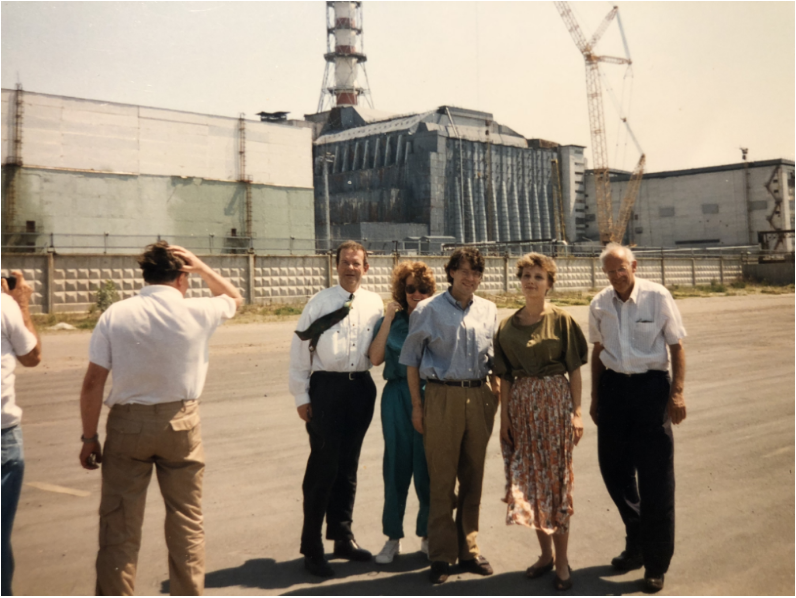
In the photo: participants of the conference in Gomel (1991) in front of the sarcophagus of the Chernobyl Nuclear Power Plant: Thomas Buchner (Munich) with his wife, Dieter Helzer (Frankfurt am Main), Elena Parovichnikova (Moscow), Rolf Net (Hamburg)
A.I. Vorobyov and his colleagues developed a method of biological dosimetry: The received radiation dose was determined by medical indicators: blood tests, reactions of the skin, hair follicles, nausea, vomiting along other symptoms.
"An informative indicator of the total body radiation dose is the number of lymphocytes in the blood, which decrease in the first few days. After two or three days, their level reflects the radiation dose," A.I. Vorobyov pointed out.
In the first days after the Chernobyl accident, almost 15,000 people with suspected radiation sickness were hospitalized. "It was necessary to figure out who really was dangerously irradiated and needed the help of a doctor, and who was healthy or sick, but the illness had nothing to do with radiation," recalled A.I. Vorobyov. This was done precisely with the help of biological dosimetry, which, according to changes in blood composition, skin changes, and the time of appearance of the first vomiting after irradiation, made it possible to accurately distinguish seriously irradiated people from those who were exposed to less intense radiation.
"Perhaps it was the Chernobyl disaster with its universal damage, panic far beyond the borders of the country, stories about balding children who fell under radioactive rain, about the death of animals and the trees losing their foliage, it was this disaster that showed that it is necessary to be able not only to run in search of dosimetrists, but also to be able to determine the dose of radiation from affected people,” – said A. I. Vorobyov.
Based on the materials of the book: A.I. Vorobyov, P.A. Vorobyov, “Before and After Chernobyl (A Doctor's View).”— M, 1996.