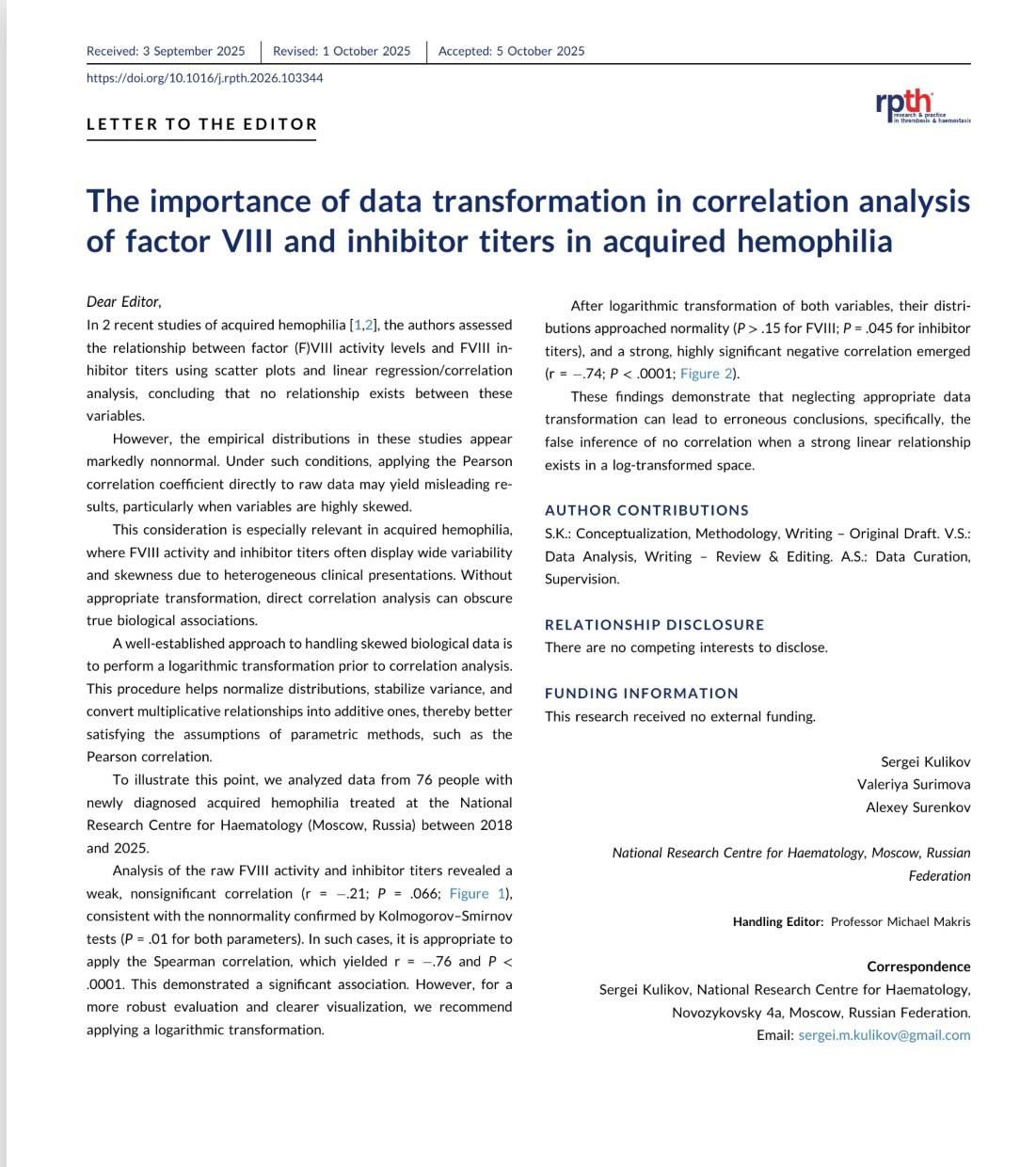






Scientists from the NMRC for Hematology of the Ministry of Health of the Russian Federation sent a letter to the editorial board of the international journal Research and Practice in Thrombosis and Haemostasis (RPTH) titled "The Importance of Data Transformation in Correlation Analysis of Factor VIII Titers and Inhibitors in Acquired Hemophilia."
In a letter to the editor-in-chief, Sergey Kulikov, Head of the Information and Analytics Division; Valeria Surimova, a specialist from the division; and Alexey Surenkov, a clinical laboratory diagnostics physician from the Hemostasis Pathology Group of the Centralized Clinical Diagnostic Laboratory, drew the attention of the foreign authors to the incorrectness of assessing the association between these key factors.
“Acquired hemophilia is a hypocoagulation blood coagulation disorder that occurs due to the formation of inhibitory autoantibodies to plasma factor VIII. Clinically, the disease manifests as spontaneous bleeding of varying location and intensity, which can pose a threat to the patient's life,” explains Alexey Surenkov.
The first mentions of the disease in medical literature date back to the 1940s, when this pathology was referred to by terms such as “pseudohemophilia,” “hemophilia-like disease,” or “female hemophilia.” In the second half of the 20th century, the term “acquired hemophilia” was first formulated, and the first convincing scientific data were presented.
Insufficient knowledge of acquired hemophilia and low awareness among doctors often lead to untimely verification of the diagnosis, which significantly increases the risk of life-threatening bleeding. Furthermore, diagnosis is complicated by the limited availability of methods for determining inhibitors to factor VIII, which play a key role in the pathogenesis of the disease. The mechanism of disease development lies in the fact that due to a disruption of the body's immune tolerance, inhibitors (autoantibodies) are formed that suppress the activity of factor VIII, leading to impaired blood coagulation and the occurrence of bleeding.”
The authors of the original article could not find a relationship between the level of clotting factor VIII (FVIII) and the titers of inhibitors to it. However, the Russian experts noted that the data distribution in the sample deviated significantly from a normal distribution.
“In such cases, using the standard Pearson correlation without preliminary data processing (such as logarithmic transformation) is risky. This can lead to false conclusions.
When we applied correct analysis methods (logarithmic transformation and non-parametric Spearman correlation), the picture changed. The data showed that a relationship does exist,” noted Sergey Kulikov.
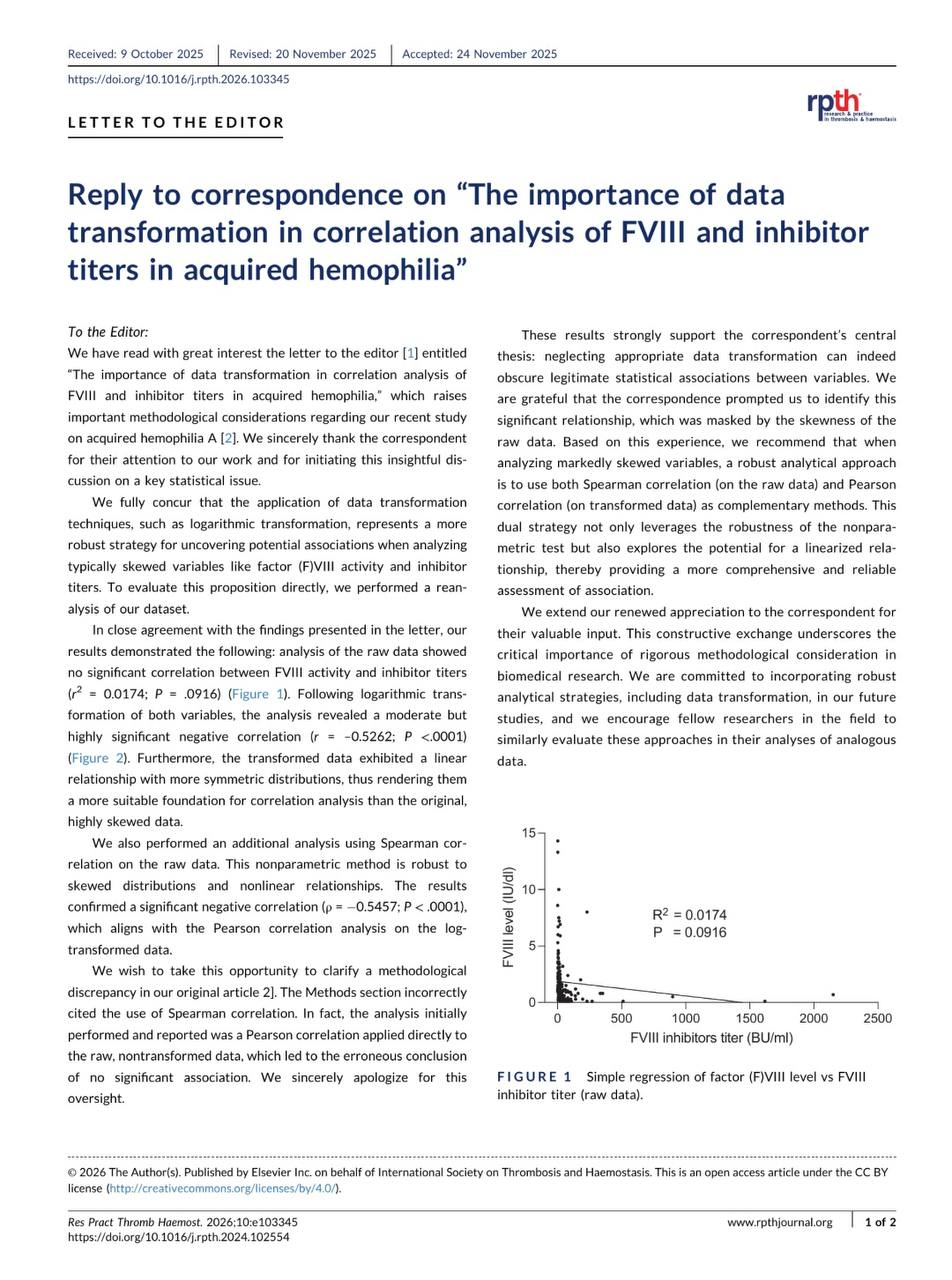
The authors of the original article not only agreed with the comments but also thanked the Russian specialists for their “attention to the work” and “in-depth analysis.” They re-analyzed their data and confirmed the correctness of the experts from the National Medical Research Center for Hematology:
“We fully agree that neglecting proper data transformation can lead to erroneous conclusions... We are truly grateful to the correspondents for initiating this in-depth analysis.”
Furthermore, the foreign colleagues acknowledged a methodological inaccuracy in their original article (incorrectly citing Spearman's criterion instead of Pearson's) and apologized.
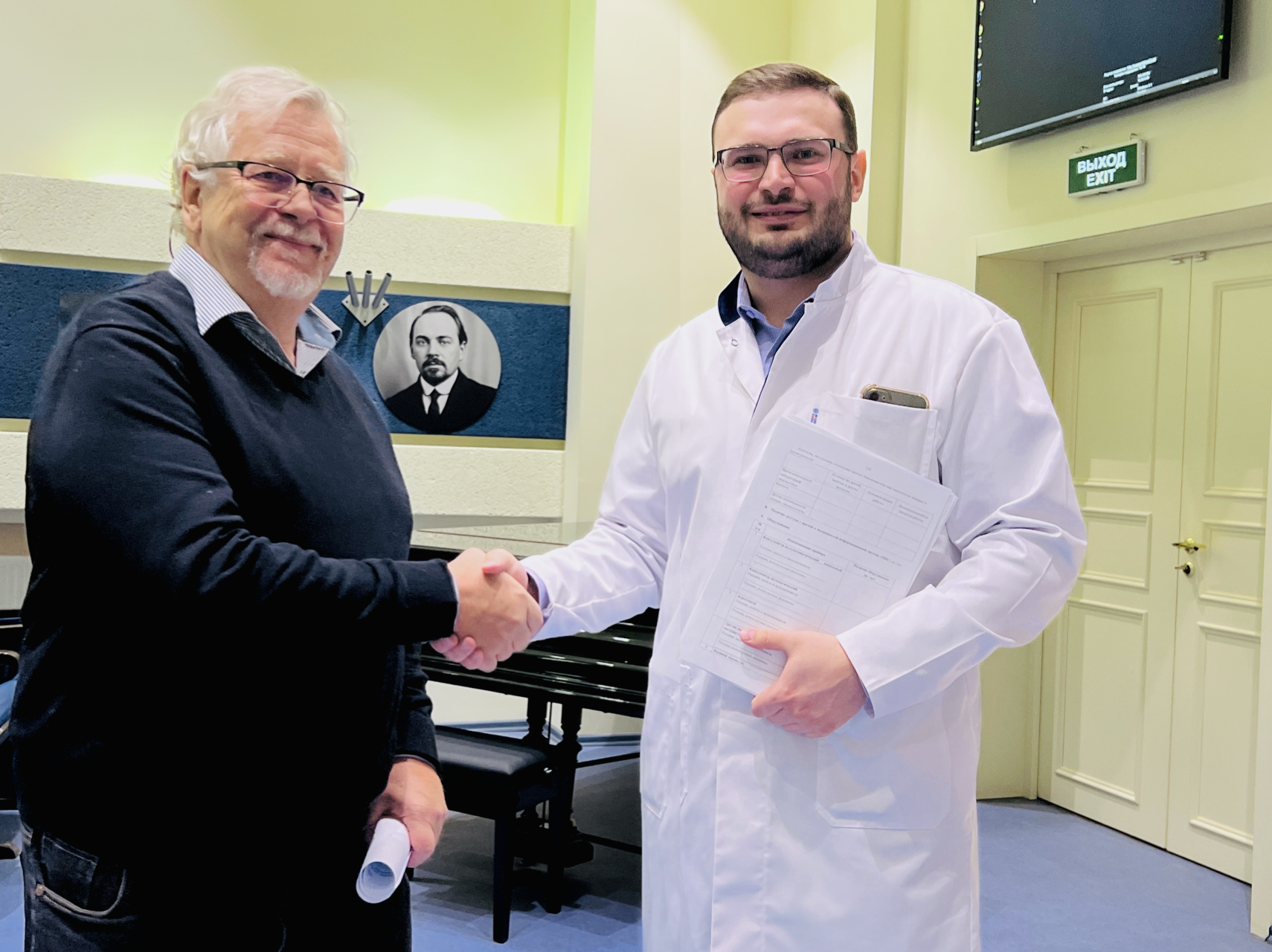
This scientific dialogue was not merely a dispute over numbers. It was about the correct interpretation of data, which doctors may rely on in the future when treating patients with severe hemostatic disorders. The Russian experts once again demonstrated that the quality of medical research requires rigorous mathematical validation.