




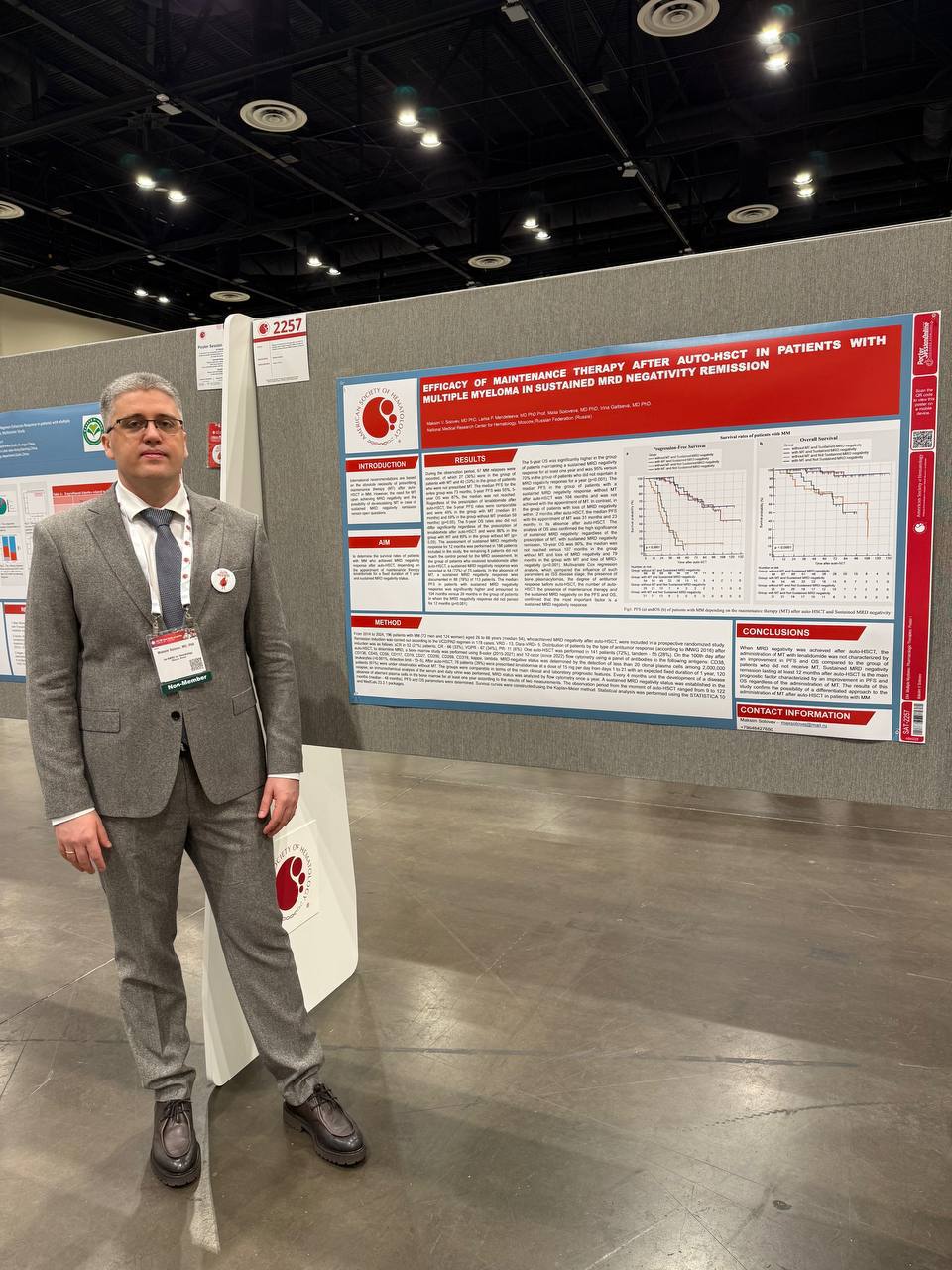
At the 67th ASH Annual Meeting and Exposition in Orlando, USA (6-9 December), a poster presentation titled “Efficacy of maintenance therapy after AUTO-HSCT in patients with multiple myeloma in sustained MRD negativity remission” was presented. Authors: Cand. of Med. Sc M.V. Soloviev; Dr. of Med. Sc. L.P. Mendeleeva; Cand. of Med. Sc M.V. Solovieva.; Dr. of Med. Sc.I.V. Galtseva
The study clarifies the role of lenalidomide maintenance therapy upon achieving MRD-negative remission after autologous hematopoietic stem cell transplantation (auto-HSCT) in multiple myeloma. It has been proven that achieving MRD-negative status after auto-HSCT in patients with multiple myeloma is associated with improved progression-free survival (PFS) and overall survival (OS).
The vast majority of guidelines are based on the absolute necessity of prescribing maintenance treatment following auto-HSCT, for which lenalidomide is an essential component. Recommendations on the duration of maintenance therapy after auto-HSCT vary from 1-2 years until MM progression.
In recent years, research results have been published demonstrating the possibility of a de-escalation approach when prescribing post-auto-HSCT maintenance upon achieving a sustained MRD-negative response. However, a current challenge is determining the necessity of maintenance therapy upon achieving MRD negativity, as well as the possibility of discontinuing lenalidomide after a fixed treatment duration of 1 year in cases of sustained MRD-negative remission.
The aim of this work was to study sustained MRD negativity and to determine PFS and OS in MM patients after auto-HSCT who achieved MRD-negative remission, depending on the prescription of lenalidomide maintenance therapy with a fixed duration of one year; sustained MRD was investigated.
In conclusion, the authors note that the study obtained comparable rates of progression-free survival and overall survival in patients who achieved MRD-negative status after auto-HSCT, regardless of whether they received lenalidomide maintenance treatment or not.
Prescribing additional treatment after auto-HSCT to patients in MRD-negative response lacks a pathophysiological basis, is associated with the risk of adverse events, and is not characterized by improvement in PFS and OS rates. A sustained MRD-negative response for one year after undergoing auto-HSCT is a favorable prognostic factor, characterized by maximum progression-free survival and overall survival, irrespective of the prescription of maintenance therapy.